

Inside Washington's nutrition overhaul
Come with me inside the Don James Center, new home to UW's athlete dining hall.

SEATTLE — I prepared for Washington’s first spring football practice last month by eating like a football player.
Or, rather, I sampled a variety of foods made available to football players — and the rest of Washington’s athletes — even if my own nutritional choices were not guided by professional counsel.
Sirloin steak? Sure. Chicken tenders? Of course. Mashed potatoes were a no-brainer, and I had to try the char-broiled “smokin’” tempah. Throw in some jasmine rice, lemon-thyme carrots and a flatbread, and my plate was full.
I was there to learn about the new Don James Center athlete dining hall from Mike Dillon, UW’s senior associate athletic director for health and performance who helped usher the roughly $5 million, donor-funded project. (Avid readers might recognize Dillon as the driver for the final leg of Rome Odunze’s Tucson-to-Seattle journey.)
He ate a salad.
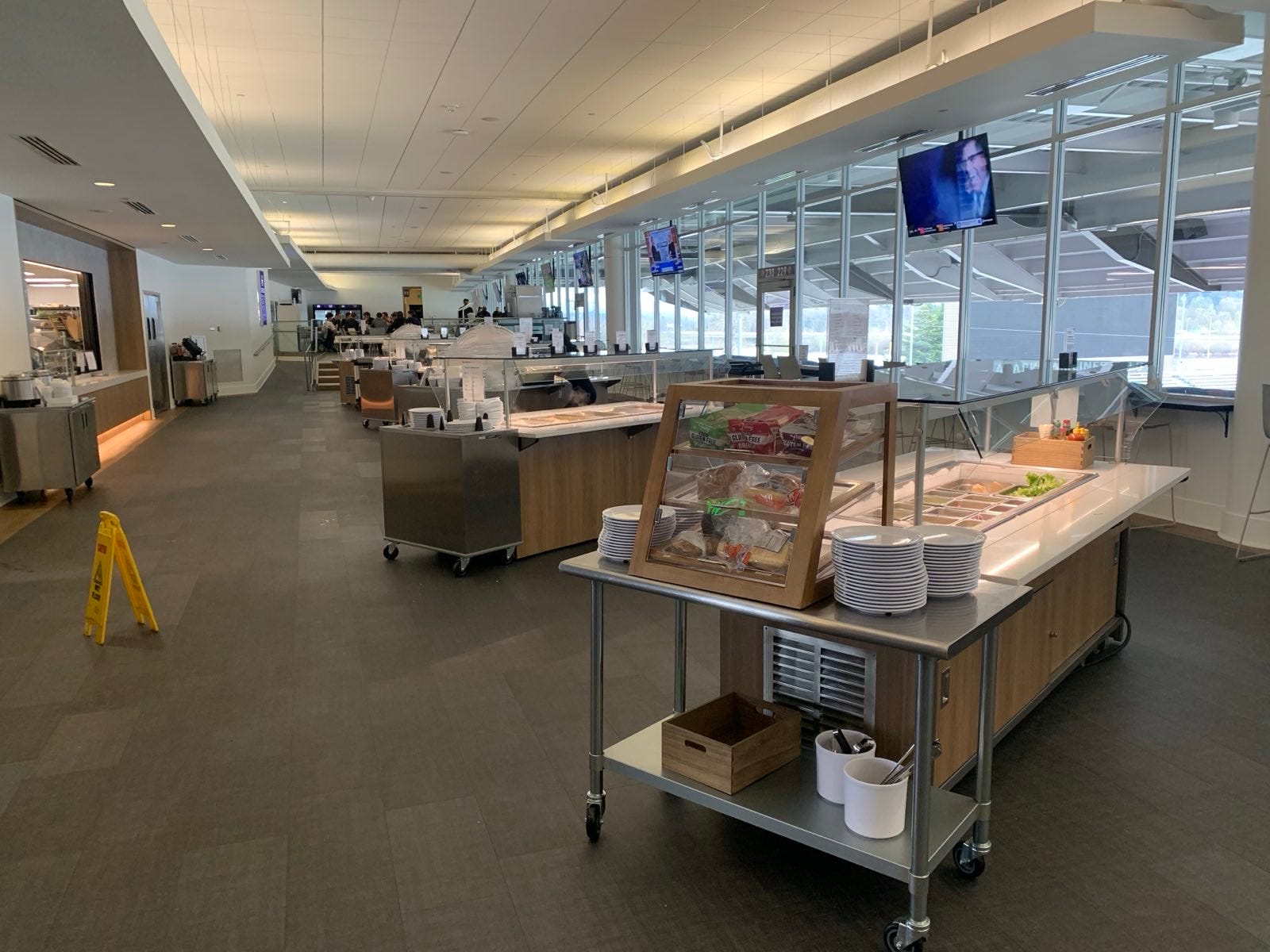
Meal options abound in the DJC, which for years served primarily as a premium-seating structure on Husky Stadium’s north side, though it occasionally hosts other events like introductory press conferences for new coaches. It still will provide premium seating for football games, but has a new year-round function as the home to an expanded dining hall open to all UW athletes, scholarship or not. Athletic-department staff can even eat there for $10 per meal. (It’s unclear how the impending House v. NCAA settlement might affect certain benefits for some of UW’s teams next school year, but I’m told all athletes will continue to have access to the DJC in some capacity.)
Lunch is served Monday through Friday from 11 a.m. to 2 p.m., and dinner is served Monday through Thursday from 4:30 to 8 p.m. Football and men’s and women’s basketball players also have access for breakfast from 7 to 9:30 a.m., with features like a made-to-order scramble station, pancakes, french toast, a waffle machine and a panini maker. The space can be used for pre-game meals, too.
“We’re still working,” Dillon said. “This is not a fully done system.” They have plans to add an outdoor grill downstairs and another on the Off-Leash Deck inside the stadium, for example, and they installed additional power capacity to handle the panini and waffle makers.
While coach Jedd Fisch has initiated a series of facilities upgrades since arriving as Washington’s football coach, it was former athletic director Troy Dannen who spearheaded the DJC renovation in late 2023, as former coach Kalen DeBoer and the Huskies were preparing for the College Football Playoff. Both DeBoer and Fisch pointed to the need for greater investment in nutrition, particularly as the school transitioned to the Big Ten.
About 10 months later — in September, just before the start of fall quarter, and after Dannen and DeBoer had each left the school — the dining hall opened to athletes.
“This was really Troy’s vision,” Dillon said. “He saw the opportunity and he really ran with it. But it definitely came from a lot of feedback over the years.”
Dillon said fewer athletes were eating at Conibear Shellhouse, which had kitchen and storage capacity to serve only one meal per day, four days per week. The football program had its meals catered by local restaurants — high-end stuff, like El Gaucho — but even that gets repetitive after a while, Dillon said.
Plus, it’s expensive.
“Any time you cater in, you’re paying a premium on that food,” Dillon said. “Probably 20 percent of your costs are surcharges just for the catering fees. … Now, 100 percent of our expense is going to food and to staff for the presentation of the food.” There are cultural benefits, too. “There used to be a little bit of a divide between football and the rest of the teams, because they ate separately,” Dillon said.
The project required updating a downstairs kitchen that was put in for Aramark, the stadium’s food and beverage provider, also located on the north end near the DJC elevator. In addition to creating space for offices plus meeting and break rooms, UW upgraded the kitchen and storage in order to accommodate the volume of food necessary to feed 600-plus athletes twice per day.
The downstairs space includes two walk-in refrigerators and a walk-in freezer. Meals are prepared there “to a certain percentage” before being held and eventually transported upstairs, where DJC staff finish them prior to serving. When we visited around 1 p.m. on a Tuesday, Dillon told me they were working on dinner. Steak was involved.
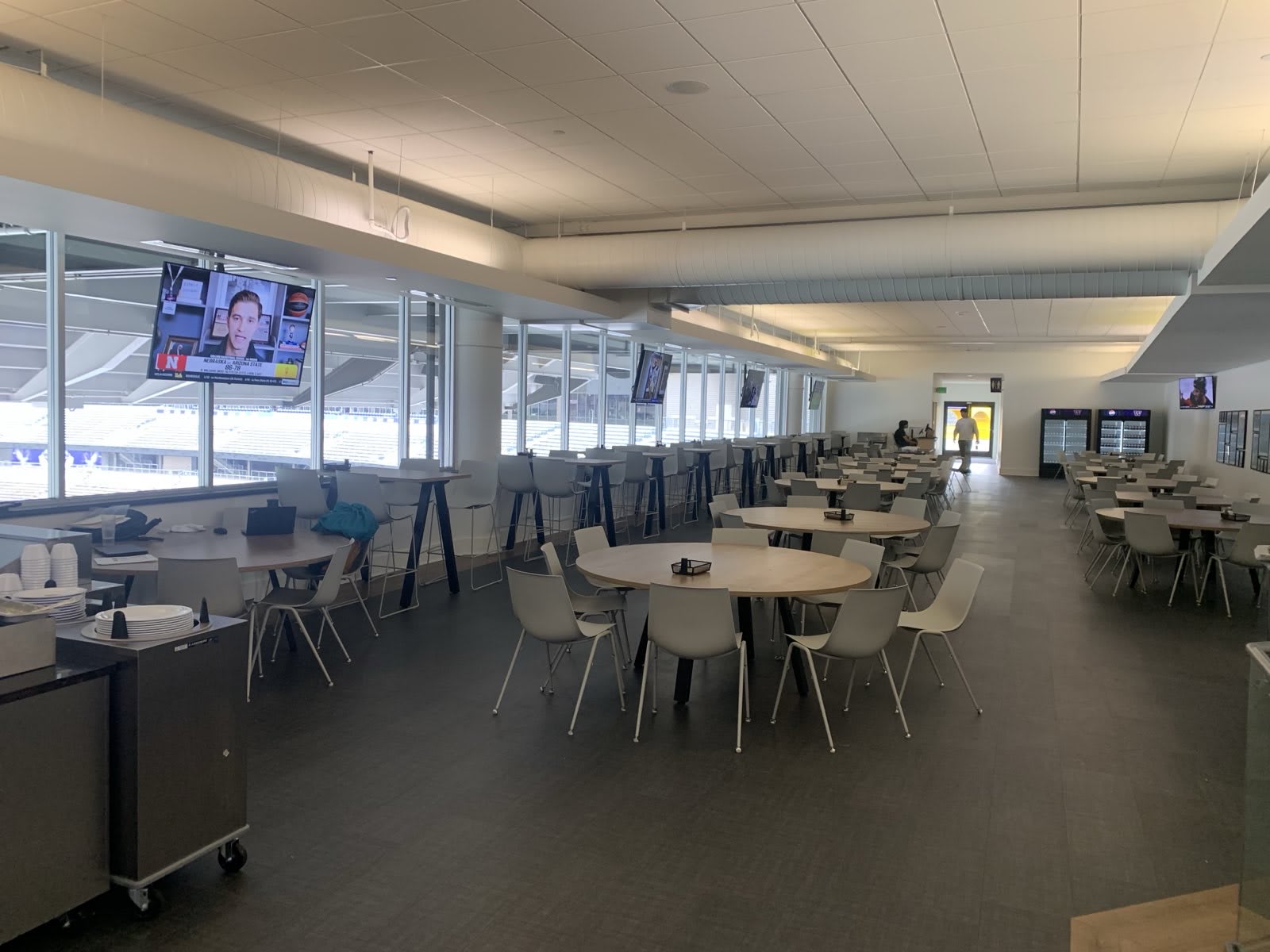
Inside the DJC, I noticed updated flooring, new paint and new tables and chairs; it’s now a “lighter, brighter space,” Dillon said, and the old carpet, in particular, was due for an upgrade. Structurally, the biggest change was moving a kitchen wall about 10 feet toward the field to create more cooking space. Dillon said they also turned a coat closet into a dish room, and there are plans to renovate the bar area (for game-day, ticket-holder purposes, and also for a more optimal smoothie space).
In order to avoid waiting on permits for drilling holes in the wall to accommodate new ventilation, UW used ventless technology for kitchen equipment; there is a “smoke-dissipation mechanism” built into each oven, Dillon said, “which is pretty fancy.” The COVID-19 pandemic necessitated cross-campus relationships that Dillon said proved beneficial during the DJC renovation; certain issues could be resolved with a quick phone call to somebody at Housing & Food Services, or Environmental Health & Safety for inspection-related matters.
DJC meal service includes five buffet stations with a rotating menu, a salad bar, a deli sandwich bar, a smoothie station, a beverage station, a soup station, a rotating hot action station — the day of my visit, it featured a barbecue sandwich bar with chicken, brisket and pork options — plus a hot-off-the-grill window serving, on this day, a cheesesteak and burger bar.
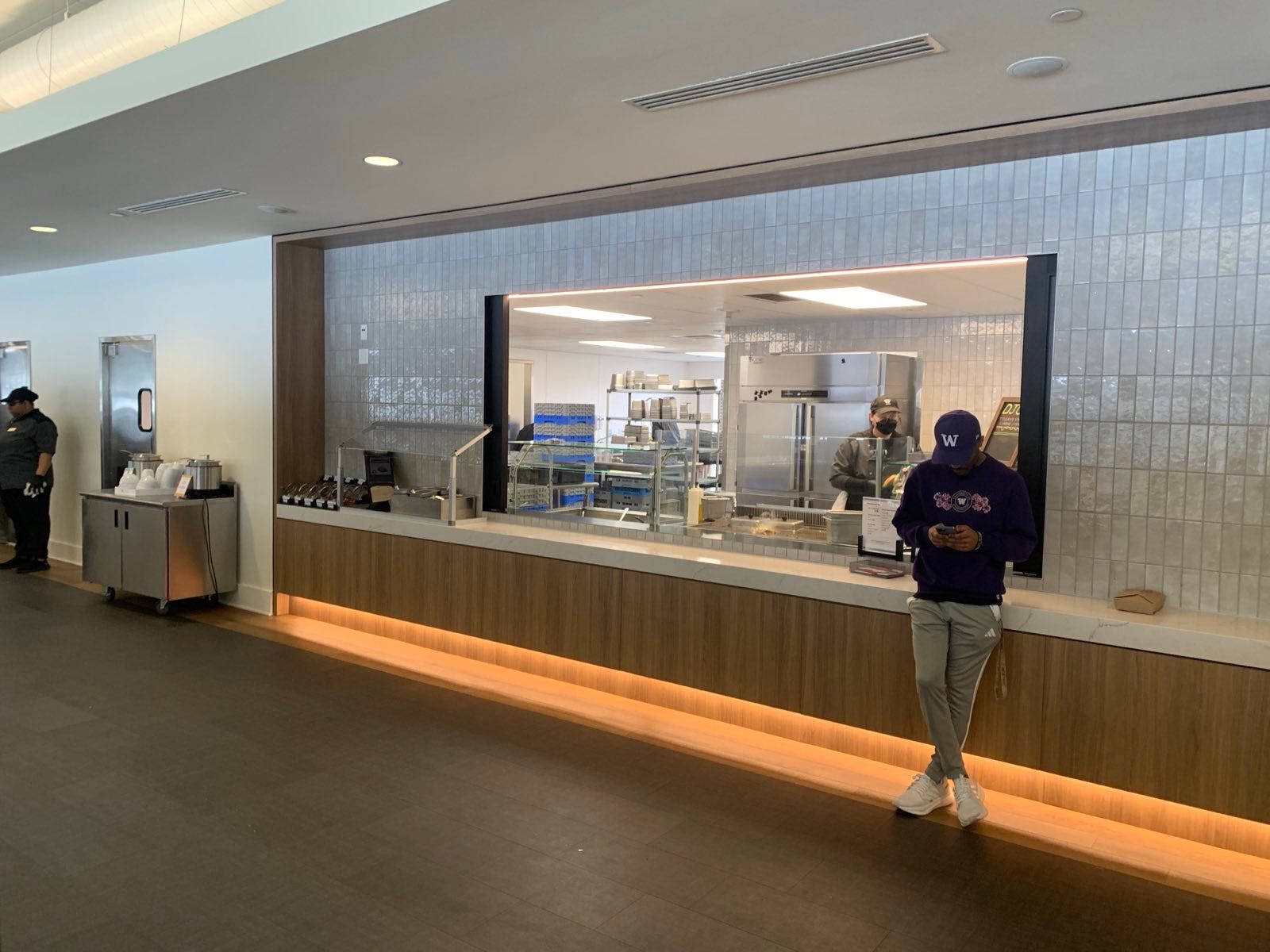
The whole operation is staffed by 28 full-time employees, plus 15 shifts per day for a rotating crew of about 60 student employees. That’s “about double” the manpower required to staff the old Conibear operation, Dillon said.
UW says it sources food from 15 different cities and towns in the state, including two beef ranches and 10 different produce providers, and that athletes eat between 200 and 300 pounds of protein per meal.
“Most of our stuff is ordered fresh,” Dillon said. “Very few things come frozen, outside of some vegetables and fruits.” Even with increased refrigerator and freezer capacity, Dillon says it’s still a “significant dance” to time food deliveries so the right food arrives on the right day.
It speaks to the cramped nature of UW’s athletics footprint that it repurposed an existing facility for the project rather than build a new one. “I can’t think of another dining hall that turns into a high-end patron gameday facility,” Dillon said. “You go and look at a lot of schools in the SEC and some of the Big Ten schools — it’s always a dining hall, 24 hours per day, seven days per week. We have to be able to turn this facility over on 24 hours notice to be ready for game day.
“But at the same time, we have a premier space that’s looking out over Lake Washington that a lot of people don’t have.”
The menus are informed by performance needs. Tanner Graves, UW’s director of football performance nutrition, works with Michelle Moreau, assistant director of football performance nutrition, plus other UW dietitians and the DJC performance chefs to discuss options and determine food sources — “getting local produce, and organic, if we can,” Graves said. He wants to serve food that players want to eat, but which is also compatible with their nutritional goals.
“We’re there at every meal for them, to be a resource to help them understand what they’re eating, how much they need to eat,” Graves said.
The program uses Notemeal, an athlete nutrition app, to provide customized meal plans for each player based on their personal needs and the time of year. “They don’t have to use it,” Graves said. “But it’s there as a resource. If guys want to get better and gain muscle mass, get stronger and faster, they have that resource to help them bridge that gap.”
During the spring, players weigh in daily at breakfast, before practice and after practice so nutrition and training staff can track their fluctuations and hydration levels; UW’s nutrition staff defines dehydration as a loss of 2 percent of body weight. Nutrition staff uses time before meetings “to assess, ‘hey, here are 10 to 15 guys we’re worried about,’” Graves said, so they can give those players electrolytes before practice. Hydration is important to prevent soft-tissue injuries. They also do “sweat-rate testing” using Nix biosensors to determine which players lose the most fluids during practice.
Graves said the team gained a collective 604 pounds of lean body mass and lost 330 pounds of body fat during winter conditioning. By the start of spring practices, for example, Graves said freshman offensive lineman John Mills weighed in at 338 pounds after arriving on campus in January at 360.
Education is a big part of Graves’ job. He was at one time a part-time professor of practice and part-time athletics dietitian at Arizona, where he had previously earned his bachelor’s in nutrition and dietetics before completing his master’s in nutrition at Lamar University. Eventually, Graves became director of nutrition for the football program under Fisch, and came to Washington last July. Fisch said UW has gone from one full-time football nutritionist to three.
UW’s eight-week winter conditioning program includes a lot of instruction from the nutrition staff about how to build a balanced plate and which food groups to focus on. Along with hydration, Graves said he emphasizes lean protein — one gram per pound of body weight is the goal for most — along with high-quality carbohydrates like whole grains.
“A lot of guys come in here and think carbs are bad for you, carbs are going to make you fat,” Graves said. “We’re an anaerobic sport. We really rely on carbohydrates as a fuel source for these guys, so that’s the majority of their diet. You need that to recover and to be ready to go for the next day, the next lift group.”
The program’s nutrition investment manifests most strikingly in the offseason transformation of star tailback Jonah Coleman, who dropped 14 pounds and cut 2.6 percent of his body fat during winter conditioning.
Coleman’s nutritional journey involved plenty of one-on-one counseling, with Graves observing that Coleman was “very, very motivated and wanting to do things the way he knew a pro should do it. He was texting me daily on what he was eating for meals. We were in constant communication on what he was eating.
“This team’s been one of the better ones I’ve been a part of, as far as that goes. They’ve been very, very open to learning, very curious.”
When I asked for a rundown of Coleman’s meal choices after a practice this spring, he said he’d started the day with a waffle, plus scrambled eggs with bacon and two more eggs, cooked over-easy; breakfast is about loading up on carbs. He added some fruit and made sure to drink plenty of water before heading to class, after which he grabbed a shake made by the nutrition staff. “I can’t really make it to lunch, because my classes are kind of overlapping into when we start meetings and stuff,” Coleman said.
Dinner depends on whether it’s a designated day for staff to load money on the Red Card Athletics per diem system. Red Card, Dillon said, is a debit card that allows athletes to use pre-paid, use-it-or-lose-it meal money at local restaurants with whom UW has partnered. Staff use it to feed athletes on days when they wouldn’t otherwise come to the facility — “do they really want to come here on a day off to eat three meals?” Dillon said — and also to allow them to recharge away from campus.
Coleman’s go-to is Chipotle, where he orders a double-steak bowl with lettuce on the bottom, plus cheese and guacamole. “I try to eat clean a little bit,” he said. “I have my cheat meals every now and then, but usually (I’ve) been trying to stay consistent.”
Graves doesn’t like the term “cheat meal,” because, he says, “you’re not necessarily cheating.” Rather, he wants players to follow the 80-20 rule — high-quality, performance-aligned foods 80 percent of the time, with the other 20 percent available for something more indulgent.
“They are kids. They’re going to go out and enjoy themselves on the weekends,” Graves said. “So (it’s about) understanding that not one food group is bad, but to make the correct choices that you need to, and understanding how to be consistent.”
To his point: sophomore quarterback Demond Williams Jr. said he eats regularly at the DJC, but some days might grab a double cheeseburger and fries from Shake Shack for lunch.
A recent example of a Don James Center dinner menu includes creole chicken, herb-roasted striploin, balsamic pork medallions and white bean cassoulet (a vegan option), plus sides of smoked cheddar mac and cheese, herb-roasted potatoes and honey-glazed carrots, and a made-to-order loaded potato wedges bar. Weekly menus are posted on the UW Performance Nutrition Instagram page, which also includes other basic nutrition information such as recipes, snack suggestions and Red Card app instructions (and my personal favorite, a post about how to spot bogus nutrition influencers on social media).
When we spoke, Graves said the program also had plans to retrofit its fueling station, located on the first floor of the football operations facility next to the weight room. That’s where players get custom shakes, snacks and pre- and post-practice supplements.
“Each guy has something different for their needs, whether it’s decreasing inflammation, maintaining body mass, whatever it might be,” Graves said. “We take a customized approach to each guy.”
The weight room underwent a major renovation last offseason. They’re turning the old team room into a players lounge and recovery room, and there are plans for an updated hydrotherapy area. The football offices and recruiting lounge have been updated.
They’re still tweaking the Don James Center offerings, too. As I eyed the buffet stations, Dillon noted one of the earliest pieces of feedback he received from athletes after the DJC opened.
The plates weren’t big enough.
Already a paid subscriber? Upgrade to On Montlake’s “Friend of the Program” tier to support independent journalism, access our monthly Zoom call and receive priority for mailbag questions.
Have you checked out the On Montlake subscriber chat? Paid subscribers can use it as a forum to discuss … well, whatever you want.
— Christian Caple, On Montlake
articles like this are why on montlake is worth every penny of a subscription. great work christian we are lucky to have you on the beat
I have heard and seen a lot of stuff about the new major emphasis on nutrition at the UW for athletes, but this makes it all much more "real" in my mind. Great write-up, Mr. Caple. I would want to try just about everything they have, at every meal. Dillon certainly sounds like he is on top of every possible aspect of this. It is absolutely worth the money - I am just glad that there are donors with the money to fund this. And I am very, very glad that ALL of the UW athletes can benefit from this new facility.