He wore No. 93 in deep purple, holding a football on one knee inside Husky Stadium, posing for a photograph on AstroTurf, the old track visible in the background. He was tall and strong, a gifted enough athlete to walk on, unrecruited, to Washington’s greatest football team ever.
Phil Green played only intramurals before joining the 1991 Huskies as a kicker. Coaches saw how he ran and jumped and asked him instead to play safety. He contributed behind the scenes, taking scout-team reps against household names. He was part of two Rose Bowl teams and a national championship. He started a family, toted his kids to UW games and played pickup soccer into his 40s.
Hunter Green wrestles with the before and after. His dad spent most of his 55 years walking and running and playing, but was forced to spend his last seven battling amyotrophic lateral sclerosis (ALS), the cruel neurodegenerative disease that weakened his body and eventually took his life.
Hunter was 14 when Phil was diagnosed. On Sunday, he’ll begin his final college season as Washington’s new punter, his second season since his father's death in July 2025.
“One of the worst things about ALS is just, like, how do you remember the person?” Hunter said earlier this year. “Him being in a wheelchair obviously wasn’t the greatest thing. I want to remember what he was like before. But at the same time, that was still part of him.”
The dad Hunter grew up with — the one who shared a locker room with some of UW's all-time greats and cheered at his youth soccer games — was the same dad who became such a relentless advocate and force for change, even as his body shut down, that his wife, Jennifer, says: “The ALS space is a better place because he had ALS, and I think anyone you talk to would say that's true."
It was how Phil resolved to live his final years, trying to turn his circumstances into something good for others.
When the Huskies begin the 2026 season with Sunday’s Apple Cup game against Washington State, Hunter will pull on No. 93 in purple.
He’ll be honoring so much more than a football legacy.
ALS is an incremental thief, robbing a person of their independence bit by bit. For Phil, it started with fasciculations in his triceps. By February 2018, the muscle twitches had moved throughout his body. Eventually, he struggled to clip his own fingernails or button his shirts. He saw a neurologist and waited. It often goes this way: by the time a doctor gives an official diagnosis, enough other conditions have been ruled out — and so much time has passed with developing symptoms — that many suffering from ALS already know what’s coming.
He had braced for months, then, for the diagnosis that finally came on Aug. 29, 2018. Phil could still walk when he and Jennifer took a belated honeymoon to Jamaica in early 2019. By the end of that year, he asked for help shaving. By mid-2020, he needed a bigger wheelchair. Jennifer fed him for roughly the last four-and-a-half years of his life.
It was a life he tried to define by what could be done, rather than what couldn’t.
That was true long before he had ALS. After college, Phil played semipro soccer for two years and tried out for the MLS expansion New England Revolution, “and made it pretty far,” Jennifer said, before beginning an eclectic career in business and technology that included stints at Sony and the Beeline Group.
They met in November 2006, watching the Apple Cup — Jennifer is a UW grad, too — at a Seattle bar with separate friend groups. They began dating shortly after, had two children together, a boy and a girl, and married in 2013. They moved to the Temecula, Calif., area around the time Hunter was in eighth grade (he remained in Redmond with his mom, Natalie, and his older sister).
"Phil and I were in love, and we were best friends," Jennifer said. "We leaned on each other for everything."
That he responded to his diagnosis the way he did — turning the negative to positive, wherever he could — surprised nobody who knew him.
"I tell people, one person shouldn't have all these amazing qualities," Jennifer said. "He was funny, witty, incredibly smart, incredibly athletic."
Jennifer once told Phil he should put together an ALS resume. Without one, a full accounting of his advocacy is practically impossible.
He was the ultimate connector, always trying to put himself or others in position to influence change.
“I would come home, and he’d be like, ‘I’m talking to this person.’ And I’d be like, ‘who?’” Jennifer said. “His reach was so far and so wide.”
Hunter remembers mornings filled with meetings during visits.
“It became his full-time job,” he said.
Blair Casey, now the CEO of the Team Gleason foundation, remembers glimpsing Phil’s committee list and remarking: “Phil, are you a robot?”
He was part of a group that successfully advocated for immediate access to social security disability benefits for those living with ALS. He testified to the Food and Drug Administration on the benefits of an ALS therapy that he received via expanded access program. He embraced the motto “nothing about us without us,” advocating tirelessly for inclusion of patient voices in clinical trials, helping to create the Patient-Central Trial Design Rating Criteria with the “I AM ALS” community. His voice was essential, too, in the passage of the 2021 “ACT for ALS” bill, which secured research funding and expanded access to experimental treatments for those living with ALS.
That was among his top priorities. ALS is a hopeless diagnosis. The way Phil saw it, any drug, any therapy that might slow symptoms or grant any degree of independence allowed at least some amount of hope to leak through the darkness.
Phil learned early on that the average lifespan after ALS diagnosis is 2 to 5 years. He didn't like that estimate.
"I think it's really what you think you can make out of it," he once said.
When people would describe him as courageous, Phil said on a 2019 episode of the Go Huskies podcast with Tony Castricone, "I'm like, no, I have no choice. Like, I have to get up every day. And if I don't have a purpose and I don't feel like I'm making a difference, then why am I getting up every day?"
In the sports world, Phil became an instrumental member of an initiative originally spearheaded by Bryan Wayne Galentine, Adam Wilson and Chuck Haberstroh to establish June 2 as Lou Gehrig Day in Major League Baseball. (They started by guessing emails of MLB front offices, Jennifer said, until they got through to one.)
“Federal funding, pharma trial access, governing committees on what the focus was for major ALS organizations, and subcommittees of those organizations,” Casey marveled. “It wasn’t about what he wanted. It was about what needed to change.”
Phil leveraged his UW ties however he could, too. On a recent morning, Casey scrolled through his inbox to find his first communication with Phil, from late 2018, about his upcoming podcast appearance with Castricone, and an upcoming feature in the GoHuskies magazine. Around the same time, Phil had proposed a partnership with Steve Gleason, the former Washington State star living with ALS, on what became the Apple Cup ALS Challenge, a fundraising competition between the two schools around the 2019 game (WSU won).
“There was a striking similarity between Phil and Steve,” said Casey, who first worked as a caregiver for Gleason in 2012, “just leveraging everything from their past to create a better future for people living with ALS.”
During his podcast interview with Castricone, Phil joked that he “literally forged” his relationship with Gleason, later apologizing to him at his gala: “'Sorry for harassing you.' But I thought it was important, right?"
Gleason wasn’t the only one.
“He had no problem going up and talking to anyone for any reason,” said Jason Crabbe, a former kicker for the Huskies and a close friend.
“He wasn’t afraid of hearing no, which a lot of people are,” Hunter said.
Phil became a Team Gleason board member and served on the technology advisory committee. He and Casey grew close, traveling together to advocate for better access to assistive technology with major software companies (Casey said Phil even offered to work an unpaid internship, if they thought it would help). Tim Cook, Apple’s former CEO, tweeted a picture with the two of them during a visit in May 2024. That was after Apple had included Green in its announcement for its Personal Voice feature, which allows people at risk of losing their voice to easily bank their speech for future use.
The duo learned how to draft off each other’s mannerisms — when to apply pressure, whom to apply it to — and became good friends and confidants. When Phil wanted to fly up for Hunter’s senior night game at Lake Washington — his first time on a plane with his big wheelchair — Casey was the only person Jennifer trusted to accompany him (airlines are not known for their delicate handling of large, expensive power chairs).
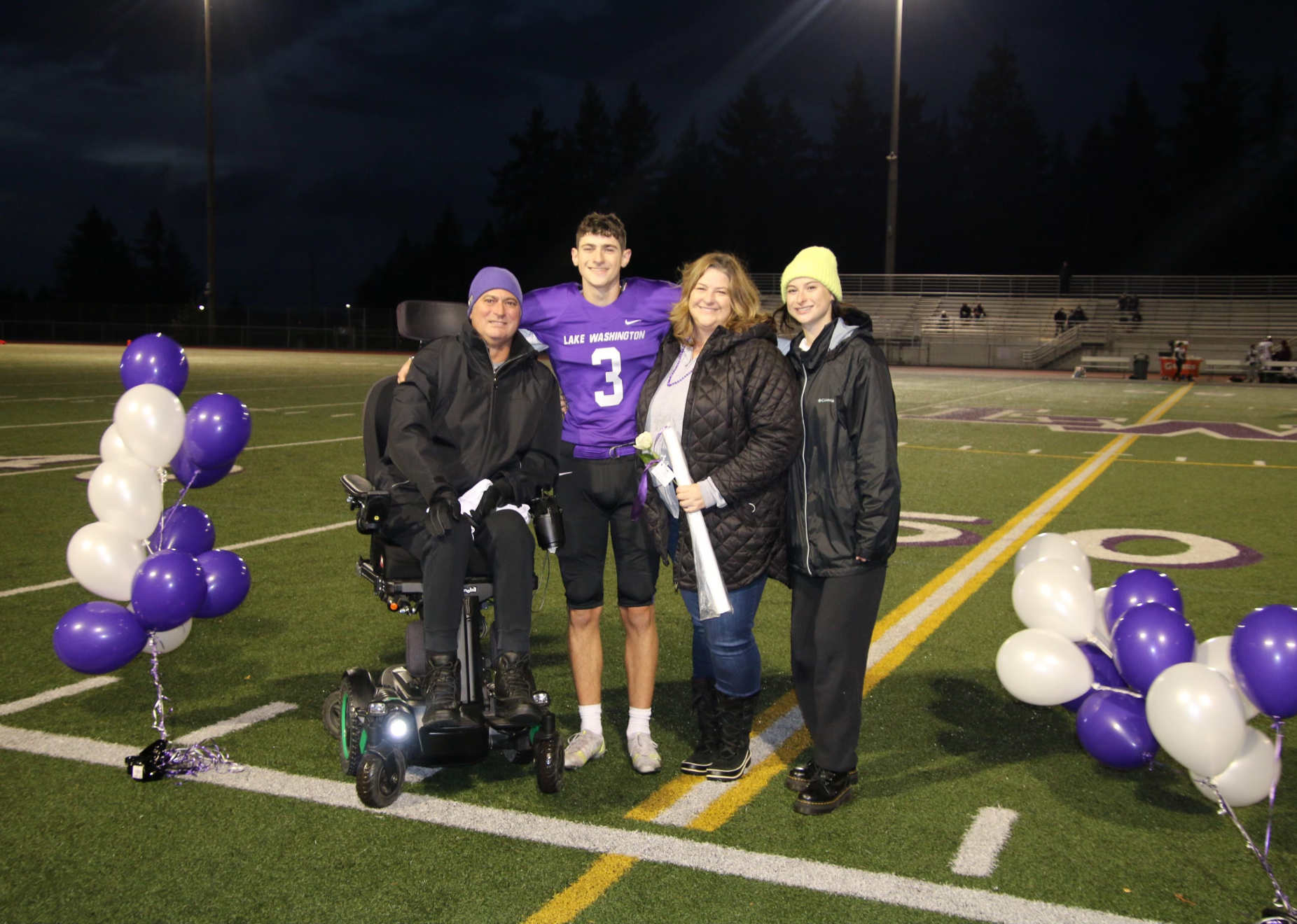
That weekend became something of an adventure. Jennifer had planned to attend a fundraiser for Augie’s Quest, another ALS research nonprofit with which Phil had become heavily involved. Casey flew from New Orleans to California to fly with Phil to Seattle, but a stomach illness floored him the night before their departure. Jennifer was alarmed, but Casey urged her to go, resolving to figure it out. First, he had to get himself to an emergency room to get an IV. (“I hate to be the bearer of bad news,” he remembers Phil telling him, “but I can’t drive.”) Phil waited nine hours for him in the van, occasionally texting to let Casey know he’d handled their flight changes.
They caught the last flight to Seattle, arriving around 1 a.m. ahead of an 8 a.m. meeting with Microsoft to discuss synthetic voice solutions.
By the end of the night, Phil watched Hunter’s team defeat Mercer Island, 28-13.
“It meant everything,” Jennifer said. “Being as far away as we were, it meant everything that he had a friend that would be able to fly out and take him. He didn’t want to miss that big moment in Hunter’s life. It was a big deal.”
Jennifer and Phil drove 18 hours overnight to attend Hunter's first game at Northern Colorado in 2022, and they made it to a few road games within driving distance. Phil watched on TV when available. Otherwise, Natalie, who attends every game, would text or email video of Hunter's kicks.
Hunter didn’t really see himself as a punter. Not at first.
Like his dad, he played soccer growing up. Jennifer and Natalie both remember Phil taking Hunter to UW camps at a young age, which was how he discovered he could kick a football.
Hunter played flag football, too, but Phil didn’t want him hitting people — or getting hit — before he understood the right way to do it. He gravitated toward kicking, and watching the ball sail through the uprights, sort of like scoring a goal in soccer. (Punting wasn’t quite as fulfilling. “I would just hit a bunch of bad punts,” he said, “and I’d be like, ‘this sucks. I don’t understand why people do this.’”)
As a senior at Lake Washington in Kirkland, though, he was a first-team all-league selection at both punter and kicker. Even though he’d traveled to attend several kicking camps — Phil attended many of them with Hunter, catching rides with friends — recruiting was hard, he said, “because I thought I was a lot better than I actually was.” Plus, the COVID-19 pandemic interrupted his junior year. He liked Oregon State, but the Beavers only offered a walk-on spot. Northern Colorado, an FCS member, at least offered a partial scholarship. It was important to him that his kicking ability help pay for college — and he wanted to go somewhere he could get on the field — so Green signed with the Big Sky school in Greeley, Colo., some 70 minutes north of Denver.
He played four games his freshman season, but was benched and wound up redshirting.
“It kind of helped me realize that I wasn’t as good as I thought I was,” he said, “and I wasn’t prepared for the moment.”
The weight room was right next to the practice field, and Hunter dedicated himself to spending most of his time between them. At 6-foot-4, he weighed 170 pounds as a freshman and 225 by his third season in Greeley. In between, as a redshirt freshman, he made 9 of 12 field-goal attempts and made honorable mention All-Big Sky as a punter.
Joey Cejudo, a former college kicker and punter who now works as an instructor in southern California, met Hunter as a “tall, goofy kid still growing into his body.” They worked together throughout Hunter’s high-school career, Hunter dropping in when visiting his dad.
“He could crush it,” Cejudo said. He encouraged Hunter early in his college career to take punting more seriously, “because it’s sloppy right now. But when you do hit one of those, it does look a little bit more NFL-ish. Just a little bit different than most kids.”
The summer of 2024, Hunter says, is when he fully embraced punting.
“I was just hitting consistently, and I was hitting a big ball,” he said. “I’d seen videos online — compared to other dudes around the country, I was kind of matching up against them.”
Hunter also got involved with ALS advocacy that year. Then-New York Jets punter Thomas Morstead, a teammate of Gleason’s with the Saints, had announced his “Punt for ALS” campaign to benefit Team Gleason. Hunter reached out asking if he could do something similar.
“He was super passionate about doing something,” Morstead said. “It was pretty cool.”
Hunter raised more than $6,000, according to the fundraiser page. Donations were tied to punts downed inside the 20-yard line.
It was a good year for it. Hunter averaged 46.4 yards per punt, made first-team all-conference and even received some All-America recognition. (One of Phil’s last Instagram posts was a video of a 53-yard field goal Hunter drilled against Colorado State. “Oh yeah,” Phil wrote, “he also averaged 48 yards on 7 punts with a long of 67.”)
It made him want to level up, to test himself against better competition.
Also: “You can’t win the Ray Guy in FCS.”
Free subscriber? Upgrade to support independent coverage of Washington Huskies football.
You can at San Diego State; Matt Araiza did it in 2021. The school’s reputation for quality punting lured Hunter after he entered the transfer portal in December 2024, and he quickly formed a strong relationship with special-teams coordinator Zac Barton.
And while it might not have been the biggest reason — Phil wouldn’t have wanted it to be — Hunter knew that attending SDSU would put him within an hour’s drive of his dad’s house as his physical condition worsened.
Phil never got to see Hunter play at San Diego State, but Hunter relished the chance to see him often in his final months, driving up just to watch TV or hang out on the weekends.
It was the closest he’d lived to his dad since eighth grade. He didn’t feel like he was visiting. It just felt like home.
“That’s something that I feel like helped me in the grieving process,” Hunter said. “Just that opportunity to see him more before he passed away.”
Jennifer knew by spring 2025 that Phil likely wouldn’t make it through the summer. Hospice nurses were visiting more frequently. She let Hunter know it was time to say goodbye.
By the end, Phil was struggling to speak, limited mostly to single-word responses, though, as is often the case with ALS, his mind remained intact. During one of Hunter’s final visits, Phil couldn’t get his Tobii eye-tracking device to work properly. Hunter had to leave. Phil started to cry. He was trying to say, “I love you.”
When Hunter returned, Jennifer said, Phil was able to tell him, in his own voice: "I'm proud of you."
He died July 19, 2025.
Hunter used to text his dad after every game, and Phil would offer simple pointers: Don’t rush. Stay calm. Keep things smooth. Hunter missed those conversations last season. It was his best year yet, as he averaged more than 46 yards per punt and made second-team All-Mountain West.
“Sometimes, there’s things I want to say to him, but I can’t,” Hunter said. “But seeing how he was before he passed away, it’s definitely hard to live like that. He’s in a better place now, and he’s not suffering anymore.”
The No. 93 was not available at Northern Colorado, so Hunter wore No. 37, the same number Gleason wore with the New Orleans Saints.
When he transferred to SDSU, he grabbed No. 93, switching from No. 29 ahead of training camp.
Even though Phil told him not to.
“Don’t wear my number — wear your number,” Phil told him.
“And Hunter was like, ‘nope, I’m doing this,’” Jennifer said with a laugh. “There’s a little bit of stubbornness in him, too.”
In the same spirit, Hunter acknowledges that his dad might not have wanted him to leave SDSU for Washington — at least, not on his behalf. His mom and stepmom both made that clear. They wanted him to be sure it was what he really wanted. And it wasn’t easy. “I wasn’t going to leave San Diego State for anywhere else,” Hunter said. He looks at it this way: it’s at least possible Barton could some day get an NFL assistant job, and Hunter could play for him then. “But I can’t play for Washington in eight years,” he said. “It has to be this year.”
He’s already taking advantage of the proximity; his mom works just across the 520 bridge in Bellevue. She’s enjoyed getting to see him at practices, and they’ve become season-ticket holders for local soccer club Ballard FC; two of Hunter’s childhood best friends, Isaac Ketcham and Luke Hammond, play for the team.
“I have pictures of the kids where Hunter was shorter than them, or just as tall as them,” Natalie said. “And then now when we see pictures, Hunter’s way taller than them. It’s just fun to have those friendships from grade school continuing on.”
The Huskies see him as a key addition in a league where field position is paramount. Special-teams coordinator Chris Petrilli believes he’s an NFL talent.
“If he keeps his head down and grinds,” Petrilli said, “he could have a real special story when this is all said and done. ... He's super-dedicated to his craft, which I appreciate. I can ask a lot of him and he just kind of answers the bell."
Jennifer liked having Hunter nearby — he’s close with all his siblings, and for a time, they all lived in the same area— and said sending Hunter back to Washington felt, in some ways, like losing another piece of Phil. But she’s excited to see him play for her alma mater, and has plans to attend four games this season. Plus, she's already heard from several of Phil's old friends who can't wait to see Hunter in purple and gold.
"That makes my heart happy, to know there are so many people rooting for Hunter," Jennifer said.
Knowing it was his decision to transfer home, Hunter said, his dad would be “amped up. He’d be super excited.”
Proud, too.
But he already was.
— Christian Caple, On Montlake
Questions? Email me: onmontlakeuw@gmail.com
Paid subscriber? Email me for an invitation to On Montlake's new Discord chat server.
Note: Clicking the "unsubscribe" link at the bottom of this email will not cancel your paid subscription. That can only be done at onmontlake.com.
Subscribe to On Montlake’s YouTube channel for behind-the-scenes video and analysis.
Get your first month free when switching to Husky Mobile, a new phone service on T-Mobile’s nationwide 5G network offering affordable plans tailored to the UW community. Check out GoHuskyMobile.com for plan details, and use code ONMONTLAKE at checkout. A portion of each bill goes back to UW athletics, and subscribers receive game-day perks like fast-pass lanes, seat upgrades and giveaways.