Take Michael Penix Jr. from Washington’s 2023 roster, and put him in the backfield with Corey Dillon, and with John Ross and Reggie Williams lined up at receiver. Maybe Lincoln Kennedy is blocking for them, or maybe it’s Chad Ward or Blair Bush or John Mills. Hunter Bryant might be playing tight end, with Ron Holmes or Jason Chorak on the defensive line, Ben Burr-Kirven or Joe Kelly at linebacker, and Budda Baker or Lawyer Milloy or Al Worley at defensive back. From the sideline, some version of Don James or Jedd Fisch or, if you’re a real sicko, Tyrone Willingham looks on.
Simulate a season with those giants playing together, and you get …
The Music City Bowl?!
Ah, well. They can’t all be winners.
Browser-based roster-building games have taken hold in recent weeks among the chronically online. The movement began with the NBA-based 82-0.com, in which the user attempts to construct a five-man roster capable of going unbeaten in a simulated season, selecting players from randomly generated teams and eras (such as the 1990s Chicago Bulls, the 1980s Detroit Pistons, or, if you’re lucky, the 1960s Warriors). Versions for the NFL, MLB, college football and even the World Cup have followed, seizing upon both the general appeal of fantasy sports and, crucially, our collective need to Remember Some Guys.
It is in that spirit that Washington’s athletic department released its own version this week: Dawg Dynasty, a roster simulation built in the 82-0 mold in which users attempt to construct a team capable of winning a simulated national championship (the development team credited NCAAF Perfect Team, specifically, for the inspiration).
If you hadn’t yet heard of it, I’m not sure whether to say “you’re welcome” or “I’m sorry.” I suppose it depends on how much work you’re trying to get done this week.
It was my journalistic duty, at least, to play the game a couple hundred ti… err, a bunch, over the last few days. To better understand how it was created, I spoke with Kurt Svoboda, Washington’s deputy athletic director for external relations, who confessed to playing it during our phone call.
“College athletics is no longer just that six- or seven-game home schedule, and the occasional road game that somebody might go to.” Svoboda said. “Fans engage with their teams every single day, and we are always looking for creative ways to keep that connection strong throughout the year.”
The idea started within the football program’s creative department and eventually pulled in more than a dozen staffers. They stood it up in less than two weeks — actually, Svoboda said, “it might have been less than a week and a half” — and launched it Monday.
“I’m a lifelong Husky before I’m anything else, and that’s really the engine behind the whole thing,” Spencer Klein, UW’s director of graphic design, said in a statement. “Where you start is the experience, not the code. From there it was a lot of late nights, fast iteration, and modern web tools that let me prototype an idea, test it live, and keep refining until every interaction felt right.
“I obsessed over the small interactive details, because those are the ones a real fan notices. This is not the end.”
Indeed, it took about a day for the game to introduce its first batch of updates, such as a live leaderboard for national championships, average wins per season and Heisman Trophy wins, and an increased degree of difficulty as the schedule progresses. The patch added 35 new players, too, and users can submit feedback — such as player requests — in a comment field.
Game play is relatively straightforward, and will look familiar for those who have played the 82-0 game or its offshoots. You click the “spin” button and are presented with a list of 10 players from one of 22 different eras of UW football. Some eras span an entire decade or more, others cover a shorter time period, and the rest comprise only a single season (1991, 2000, 2016, and each year from 2019 on, including, interestingly, the 2026 team).
Like what you're reading? Join more than 2,000 others with a paid subscription to On Montlake.
That’s the first layer of randomization. The second comes from the pool of players you select from. There are more than 400 options total across all eras — so far, anyway — but the game presents only 10 at a time, and there is no guarantee that a spin of 2023 will yield any or all of, say, Michael Penix Jr., Rome Odunze or Ja’Lynn Polk, or that Warren Moon or Michael Jackson will show every time for the 1970s, and so on. This can be maddening, but that’s part of the fun.
Spinning again after each selection, you pick, in no particular order, a quarterback, running back, receiver, tight end, offensive lineman, offensive “flex” player (an additional running back, receiver or tight end), a defensive lineman, a linebacker, a defensive back and, interestingly, a head coach. There appears nuance within that latter category, too, as not all Don Jameses (1991? 1980s? 1992-95?) are valued equally, and a certain former coach just might drag down the results of otherwise talented rosters (and it ain’t James Phelan).
As with the 82-0 genre, you receive one “re-spin” per round, to skip an arrangement of players that you don’t believe offers a suitable selection for your roster.
“There was a lot of conversation that went into the athletes and the coaches who are named in the game,” Svoboda said. “There’s balance, there’s appeal to different eras, the idea of pairing different talents at different positions.”
There is apparently some nuance involved in how players are rated across different seasons. Don’t leap at, say, Odunze or Jalen McMillan in 2020, or assume that Danny Shelton from 2011-13 will count the same as Danny Shelton from 2014-15, when he piled up sacks and tackles for loss and was voted All-America.
“Drafting a legend matters,” the “about” section states, “but so does catching him at the right time.”
Much else is left to the imagination, which, again, is part of the appeal. At running back, receiver and tight end, do you prioritize yards or touchdowns? What’s most important at quarterback — passing yards, touchdown passes, dual-threat ability or fan-favorite status? Is Corey Dillon’s singular brilliance in 1996 better than Myles Gaskin’s overall production in 2017-18? Mark Bruener was an all-time great, but he didn’t put up numbers like Austin Seferian-Jenkins or Hunter Bryant. What’s best for o-linemen — all-conference honors, NFL Draft selection, both or neither?
Then there are the long-ago legends like George Wilson and Chuck Carroll, who frequently pop up as part of the 1920-50s spin. They essentially were playing a different sport, yet were All-Americans all the same. (A slightly more modern legend like Hugh McElhenney, who finished his career in the ‘50s, was productive enough to transcend any generational debates. I generally pick him if I can get him.)
And coaching does seem to matter. If you have a chance to take Steve Emtman (1991), for example, you probably should. But if you spin 1991 and Emtman isn’t available? Lincoln Kennedy, Dave Hoffmann and Mario Bailey are tempting, but Don James could prove just as valuable.
In true college football fashion, Svoboda said, one might assemble what they believe to be the perfect roster and still lose two or three games.
“There is an element of randomness to this,” Svoboda said. “Which to me is actually one of the most endearing parts. I’ve seen some of this feedback of, ‘here’s this team I put together. How could we possibly have gone only 11-2?’ And then you share your team, and you have great interaction with people.”
Certain individuals might increase your chances, but there is plenty of flexibility to build a championship roster. I used 13 different offensive linemen to win my first 16 national championships, plus 10 different defensive backs, nine different linebackers, eight different receivers and eight different tight ends.
“There’s naturally differences in opinion, bias, value on all of those things,” Svoboda said. “I think that’s critically important here, because what you want is the game to be a reflection of that. If you were to mention a list of greats, there are probably some commonalities that fans that span generations would name the same people, and there are probably very wide variances in the number of people that would get named.”
Once you’ve completed your roster, the game quickly simulates a 12-game season, presenting final scores and home/away information for each date (but no specific opponents). Go 10-2 or better, and you typically make the Big Ten championship game, and then likely the College Football Playoff (though in a round I played earlier today, my 10-2 squad wound up in the Duke’s Mayo Bowl). If things go really well, one of your players might even win the Heisman.
My ideal roster, I think, would look something like this (era in parentheses, with none repeated):
QB Michael Penix Jr. (2022)
RB Corey Dillon (1996-99)
WR Reggie Williams (2001-03)
TE Austin Seferian-Jenkins (2011-13)
OL Chad Ward (2000)
FLEX Rome Odunze (2023)
DL Steve Emtman (1991)
LB Shaq Thompson (2014-15)
DB Trent McDuffie (2021)
COACH Don James (1980s)
But you’re quite unlikely to encounter this exact combination of eras and players, and there are countless other paths to victory (and there might not be such a thing as a "perfect" roster, anyway). Napoleon Kaufman (1992-95) and Myles Gaskin (2017-18) and Bishop Sankey (2011-13) will be popular choices at running back, as will Cade Otton (2020 or 2021) and Hunter Bryant (2019) at tight end. You could just as easily slide in John Ross (2016) at receiver, or Jackson (1970s) or Burr-Kirven (2017-18) at linebacker. And if you can’t get Emtman, someone like Zion Tupuola-Fetui (2020) accomplishes two different things — he gives you a sack machine on the defensive line, and is one of the few possibilities from the 2020 roster who can help you win a championship. That allows you to save your re-spin for later (the same might be said of Elijah Molden that year, or McDuffie and Kyler Gordon in 2021).
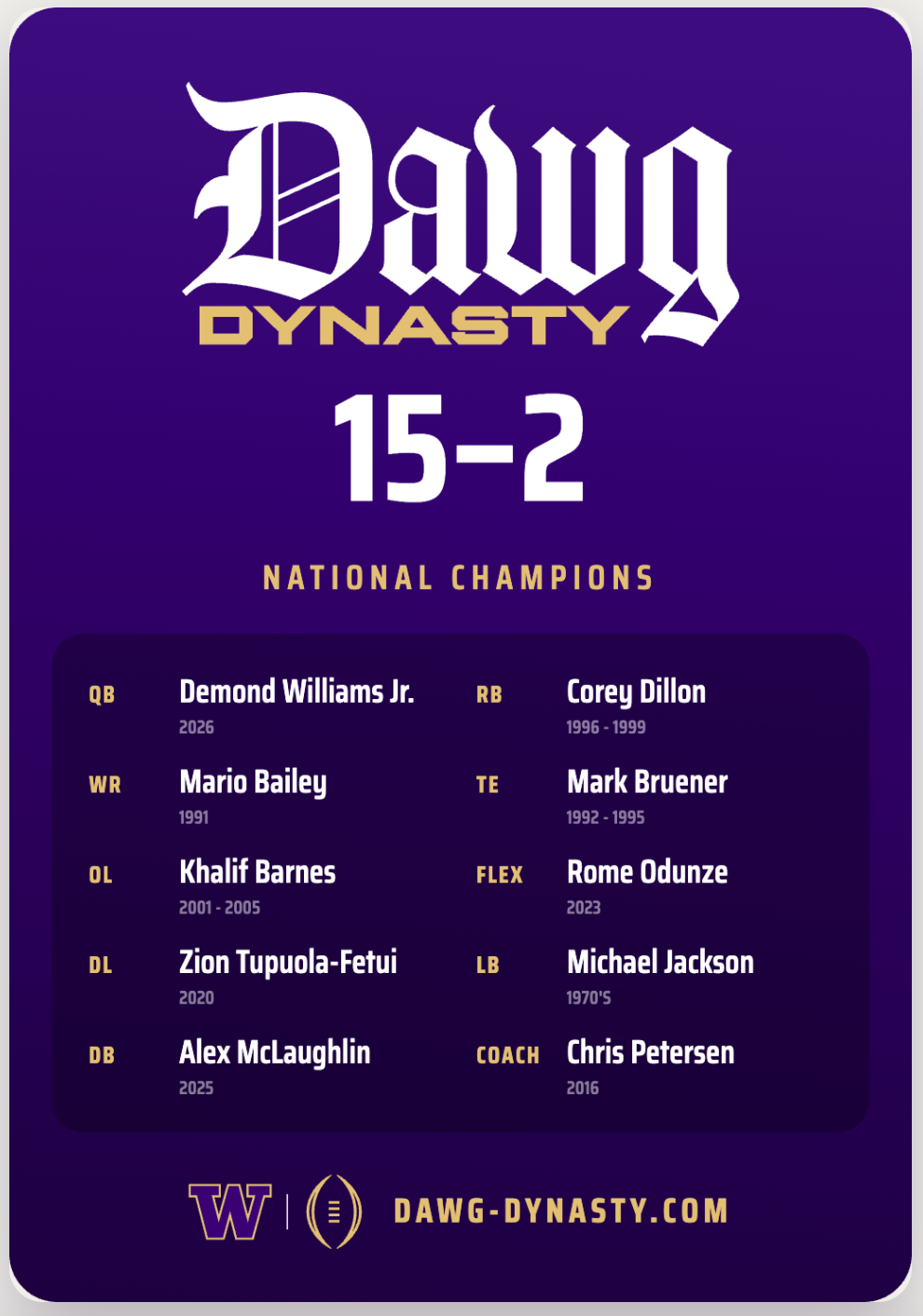
While I’ve largely relied on players from past eras to fill my rosters, I put together a national-championship squad while writing this column — do what you love, kids, and you’ll never work a day in your life — that included both Demond Williams Jr. (2026) and Alex McLaughlin (2025).
The player rating system is unclear — intentionally so, I assume — so I’ve mostly prioritized drafting players who put up big stats. But don’t discount the possibility that certain legends, especially those who played long ago, might be graded more on vibes than on pound-for-pound statistical production.
Beyond scratching that part of your brain that yearns to compile historic rosters — ahem — the game also is cause to remember individual achievements by players who might not come immediately to mind. It can be easy to forget, after all, what a menace ZTF was in 2020, or that Worley set the NCAA record for single-season interceptions with 14 in 1968, and that while Washington wasn’t exactly known for defense from 2006-10, Mason Foster sure put up huge numbers at linebacker.
“Sports are supposed to be fun, and they’re supposed to bring people together,” Svoboda said. “What our staff wanted to do was build something that sparks debate and conversation, and perhaps a little friendly disagreement among Husky fans.”
As of Thursday afternoon, the game’s website featured a new tab teasing that “new games are on the way.”
There are, after all, still 80 days before the 2026 opener.
“Fans want to participate with the program, and not just consume information or deliverables,” Svoboda said. “This is purpose-built to participate.”
— Christian Caple, On Montlake
Questions? Email me: onmontlakeuw@gmail.com
Paid subscriber? Email me for an invitation to On Montlake's new Discord chat server.
Note: Clicking the "unsubscribe" link at the bottom of this email will not cancel your paid subscription. That can only be done at onmontlake.com.
Subscribe to On Montlake’s YouTube channel for behind-the-scenes video and analysis.
Get your first month free when switching to Husky Mobile, a new phone service on T-Mobile’s nationwide 5G network offering affordable plans tailored to the UW community. Check out GoHuskyMobile.com for plan details, and use code ONMONTLAKE at checkout. A portion of each bill goes back to UW athletics, and subscribers receive game-day perks like fast-pass lanes, seat upgrades and giveaways.