

SEATTLE — Any other South Sounders relish the two-hour drive home from Husky Stadium last night?
Lane closures cannot stop The Day After column. Here are 25 more thoughts on the Huskies’ 24-6 loss to Ohio State on Saturday.
1. I posted the following poll to Twitter last night. Here are the results, with 887 votes cast so far.
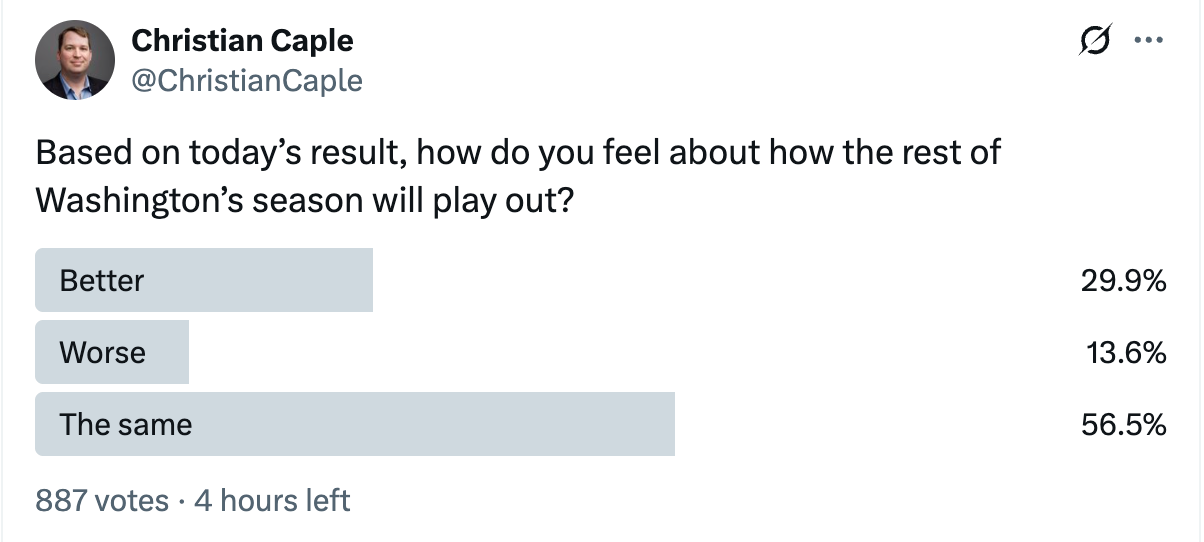
So plenty of folks believe Washington acquitted itself well enough against the defending national champions, even if the majority said the game only confirmed what they already knew, one way or the other. I’d be curious to hear more from the “worse” voters, if any are reading this.
Perhaps to that point: my own vote would lean toward “the same,” with some consideration for “better,” because I thought the first three games already told us Washington is a good bit better than it was last year, even if calibrating for strength of schedule. There was a time on Saturday when I felt the Huskies had a chance to make an unequivocal statement about the kind of team they can be this year, but that fizzled in the second half (and especially because they didn’t score a touchdown).
2. Good news, though: they have a whole eight games left to play, and I’m not sure any of them feel unwinnable based on Saturday’s result. No doubt, Oregon on Nov. 29 will be the most challenging, and the Ducks should be considered title contenders after last night’s overtime win at Penn State. UW obviously won’t be favored at Michigan, either, and Illinois presents its own challenges. But they should have at least a puncher’s chance against every team on their schedule, which isn’t something you could have said last year.
3. What happened with the sideline-interference penalty? “They said they ran into one of our coaches when he was backpedaling, but I didn’t see it,” coach Jedd Fisch said. The TV replay seemed to show that any contact occurred well after the play had ended. Though I question whether the penalty should have been called at all, the physical contact component explains why it was a yardage penalty rather than a warning, per the NCAA rulebook. A warning is assessed when players or coaches do not stay behind the coaching line, but any physical contact with an official can be penalized with a 15-yard foul.
4. That would have been a pretty slick move by Omari Evans, if his knee hadn’t touched the ground. He played 19 snaps in this game and caught both of his targets, including a 22-yard gain (on a great throw from Demond Williams Jr., layered between defenders). The Huskies need to get more out of their receivers, so Evans’ semi-emergence, along with Dezmen Roebuck, is encouraging.
5. Ohio State faced little resistance on its opening drive until it reached the red zone. Great play by Deven Bryant and Xe’ree Alexander to plug the gap on the fourth-down stop. Give UW’s defense credit for bowing up on a short field. I actually thought the Huskies’ run defense held up pretty well, especially without Buddah Al-Uqdah and Zach Durfee. Just as the Huskies lamented their own red-zone failures, though, I’m sure Ohio State would point to that play and bemoan their own inability to finish a drive near the goal line. One more yard, and they likely would have scored points on five of six (full) possessions in this game.
6. The fake field goal looks as bad today as it did in the moment. Fourteen yards is a long way to go in that situation. It sure looked like Decker DeGraaf was anticipating some action behind him, because he ran upfield to block and wasn’t looking for a throw. Even if he had been, Ohio State was all over it. A 45-yarder is no sure thing, but Grady Gross is plenty capable of making from that distance. If he does, you lead 6-0, and Ohio State’s subsequent two touchdowns leave you within one score instead of two. I can see the logic in opting for trickery: you’re the underdog, nothing is going to come easy against Ohio State’s defense and you need to manufacture a break or two at some point. That was such a longshot, though, and did seem to take some air out of the stadium.
7. Since we’re second-guessing things that didn’t work: I don’t quite understand the risk vs. reward calculation on UW’s all-out blitz, which led to Ohio State’s first touchdown. The ball was snapped at the 18-yard line. Say you get home for a sack. That’s, what, an 8-yard loss, maybe? Call it a 43- or 44-yard field goal, then? Ohio State kicker Jayden Fielding was 7-for-8 from 40-to-49 yards last season. He’s a senior who makes kicks at an 80.5 percent clip for his career. Backing him up an extra seven or eight yards was worth the risk of giving up a touchdown on third-and-11 in the red zone? I don’t hate the aggression from Ryan Walters, but that blitz seemed out of alignment with a gameplan built around forcing shorter throws and keeping things in front of them.
8. Williams made a few really good throws in this game, including a couple to Roebuck, who caught three of UW’s six longest pass plays (16, 18 and 20 yards). Williams finished 18-for-22 for 173 yards, though Fisch would have liked him to have a couple more incompletions, if it meant avoiding one or more of the six sacks he took.
“I’ve got to help Demond understand that an incompletion is OK sometimes,” Fisch said. “He doesn’t throw many incompletions at all. Sometimes — sometimes — that leads to holding the ball a little bit longer, and unfortunately, at times, can turn into a sack. But Demond is exceptionally accurate. He’s really good with the ball. He makes extremely good decisions. He protects the ball at all costs.”
9. For the first time this season, John Mills played every snap at left guard. Despite the sack numbers, the o-line actually graded pretty well in pass protection — Williams was sacked on six of the 13 dropbacks on which he was pressured, per PFF, which assigned only two of Ohio State’s sacks to UW blockers, and only one to an offensive lineman — and I don’t recall them allowing any free runners that blew up a play before it could really get going. The difference was Ohio State’s speed and pursuit when Williams hung in the pocket too long, and the Buckeyes were generally tough against the run, too, as basically half of Jonah Coleman’s 70 rushing yards came on one play, and eight of his 13 carries went for three or fewer yards. Of course, limiting Coleman to 13 carries is a big key to limiting those explosive runs. I saw some criticism of Fisch for not leaning on Coleman more in this game, but I’m not sure that was going to be a winning plan against Ohio State’s front.


